
There’s a point in every engineering project where things stop being simple. You start with clear boundaries – this component does this, that subsystem handles that – and everyone understands their piece of the puzzle. But then the connections multiply. Suddenly you’ve got software talking to hardware, which interfaces with sensors, which feed back into control systems, which affect mechanical components. And the old ways of managing all this? They start falling apart pretty quickly.
This isn’t just about projects getting bigger. It’s about them getting more entangled. A change in one area ripples through five others. A single requirement touches dozens of components. The challenge isn’t tracking more things – it’s tracking how everything relates to everything else.
When Documentation Becomes the Problem
Traditional engineering relied heavily on documents. Specifications, interface control documents, requirements matrices, design descriptions. For decades, this worked fine because systems were relatively modular. You could hand someone a 50-page spec and they’d know everything about their subsystem without needing to understand the whole picture.
But here’s where it breaks down: documents are static snapshots frozen in time. When you’ve got a system where Component A talks to Components B, C, and D, and each of those has its own connections, your documentation becomes a nightmare to maintain. Change one interface and you’re hunting through multiple documents to update every reference. Miss one? Now you’ve got inconsistencies that won’t show up until integration testing, when fixing them costs ten times more.
The real problem isn’t the volume of documentation. It’s that documents can’t show relationships dynamically. They describe things in isolation, which works fine until isolation stops being the reality of your system.
The Shift Toward Connected Models
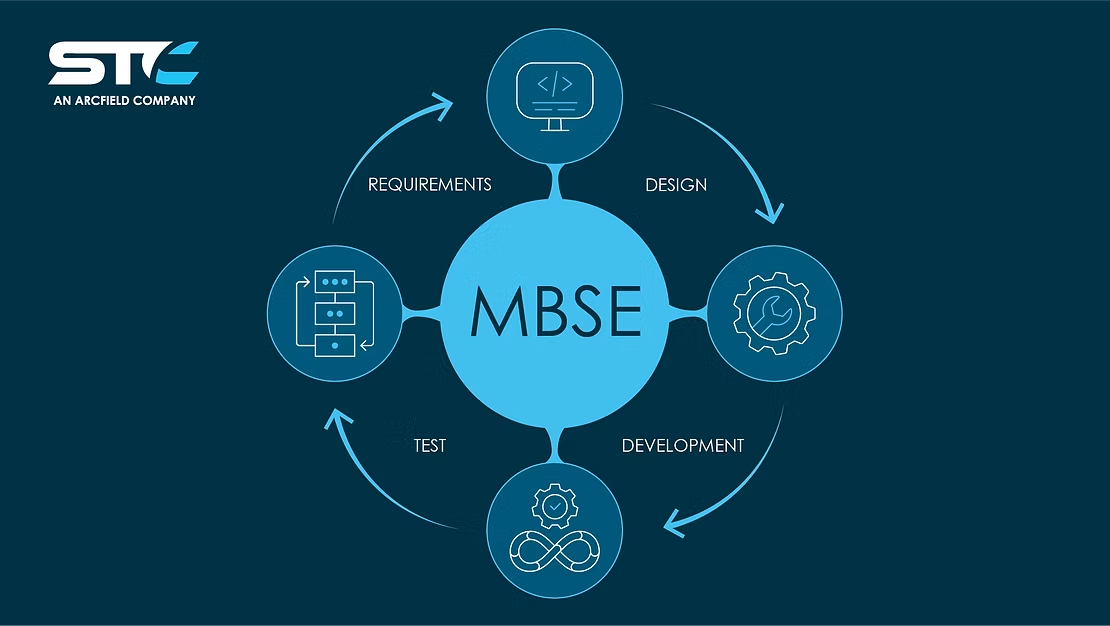
Organizations facing these complexity issues have been gravitating toward different approaches. Instead of describing systems in separate documents, model based systems engineering creates a unified representation where all components, interfaces, and requirements exist in relationship to each other.
Think of it as the difference between describing a city with a series of written directions versus showing someone a map. The map lets you see connections, trace paths, and understand how different areas relate. Written directions might get you from point A to point B, but they don’t give you the bigger picture.
This matters more as systems become more interconnected because changes propagate automatically. Update an interface in the model and every component that uses that interface reflects the change. You’re not hunting through documents hoping you found every reference.
What Actually Changes in Daily Work
The shift isn’t just philosophical, it changes how engineers spend their time. In document-based processes, a significant chunk of the day goes to reconciliation work. Checking if the requirements document matches the interface specification. Verifying that the test plan still aligns with the design document. Making sure everyone’s working from the latest version of the right document.
With interconnected model-based approaches, that reconciliation happens automatically. The model enforces consistency. If something doesn’t match, you know immediately rather than discovering it weeks later during integration.
But this also means engineers need to think differently about their work. Instead of owning a document that describes their subsystem, they’re contributing to a shared model. Changes are visible to everyone instantly. There’s less ability to work in isolation, which can feel uncomfortable at first but ultimately reduces surprises.
The Interface Management Challenge
Interfaces are where interconnected systems get truly complicated. In a moderately complex product, you might have hundreds of interfaces between components. Each interface has protocols, data formats, timing requirements, and error handling behaviors. Manage this through documents and you end up with interface control documents that are either so detailed they’re impossible to maintain or so high-level they’re practically useless.
The problem gets worse when systems span multiple engineering disciplines. The electrical engineers document their interfaces one way. Software engineers use a different format. Mechanical engineers have their own standards. Getting these to align requires constant translation and checking.
Modern approaches address this by making interfaces first-class objects in the model. An interface exists once, with all its properties defined, and every component that uses it references that single definition. Change the interface and you immediately see every affected component. You can run impact analysis in minutes instead of days.
When Requirements Touch Everything
Here’s something that catches teams off guard: in highly interconnected systems, most requirements aren’t isolated to single components. A performance requirement might affect processor selection, software architecture, cooling design, and power distribution. A safety requirement could touch twenty different subsystems.
Traditional requirements management tools track these relationships through links and cross-references, but it’s manual work. Someone has to create each link, maintain it, and verify it’s still accurate. In a system with thousands of requirements and hundreds of components, this becomes a full-time job that never really gets completed.
The shift toward model-based methods embeds requirements directly into the system architecture. A requirement isn’t just linked to components – it’s allocated to them, traced through design decisions, and verified through test cases, all within a connected structure. You can ask “what implements this requirement?” and get an answer that includes every relevant component, interface, and verification method.
The Learning Curve Reality
None of this transition happens easily. Moving from document-centric to model-centric engineering requires teams to learn new tools, adopt new processes, and most challenging of all, change how they think about their work. The first few months are usually rough. People want to fall back on familiar document templates. They’re not sure how to represent their subsystem in the new format. Meetings take longer because everyone’s still figuring out the basics.
But there’s a turning point – usually around six to nine months in, where things start clicking. Engineers realize they’re spending less time in reconciliation meetings. They catch interface mismatches earlier. They can answer “what if we change this?” questions in hours instead of weeks. The model becomes the source of truth rather than a parallel artifact that needs to be kept in sync with documents.
Why Traditional Methods Hit a Wall
There’s nothing inherently wrong with document-based engineering for simple systems. The problem is that “simple” is becoming increasingly rare. Even products that seem straightforward, a consumer appliance, a piece of industrial equipment – have embedded software, sensors, connectivity, and control systems that create complex interactions.
Traditional methods assume you can decompose a system into relatively independent pieces, document each piece thoroughly, and integrate them later. This assumption breaks down when independence is no longer realistic. When every piece depends on multiple other pieces, and those dependencies change frequently, documents can’t keep up.
Making the Transition Work
Organizations making this shift successfully tend to do a few things right. They start with a pilot project rather than converting everything at once. They invest heavily in training, not just on tools but on the underlying methodology. They accept that productivity will drop initially and plan accordingly.
They also recognize that tools alone don’t solve the problem. You can have the most sophisticated modeling environment available and still fail if the team doesn’t understand why they’re using it or how to structure their work differently. The methodology matters as much as the technology.
The payoff comes when dealing with change, which in interconnected systems means constantly. When a customer changes a key requirement or a component becomes unavailable or a new regulation gets introduced, model-based approaches let teams assess impact and adapt much faster than document-heavy processes allow. In industries where time-to-market and adaptability drive competitive advantage, that speed matters a lot.
 Edward